
Monster Black Hole Defies Physics, Growing 2.4 Times Beyond Theoretical Limit
Astronomers discover an ancient supermassive black hole that's breaking the rules of physics by growing faster than should be possible.
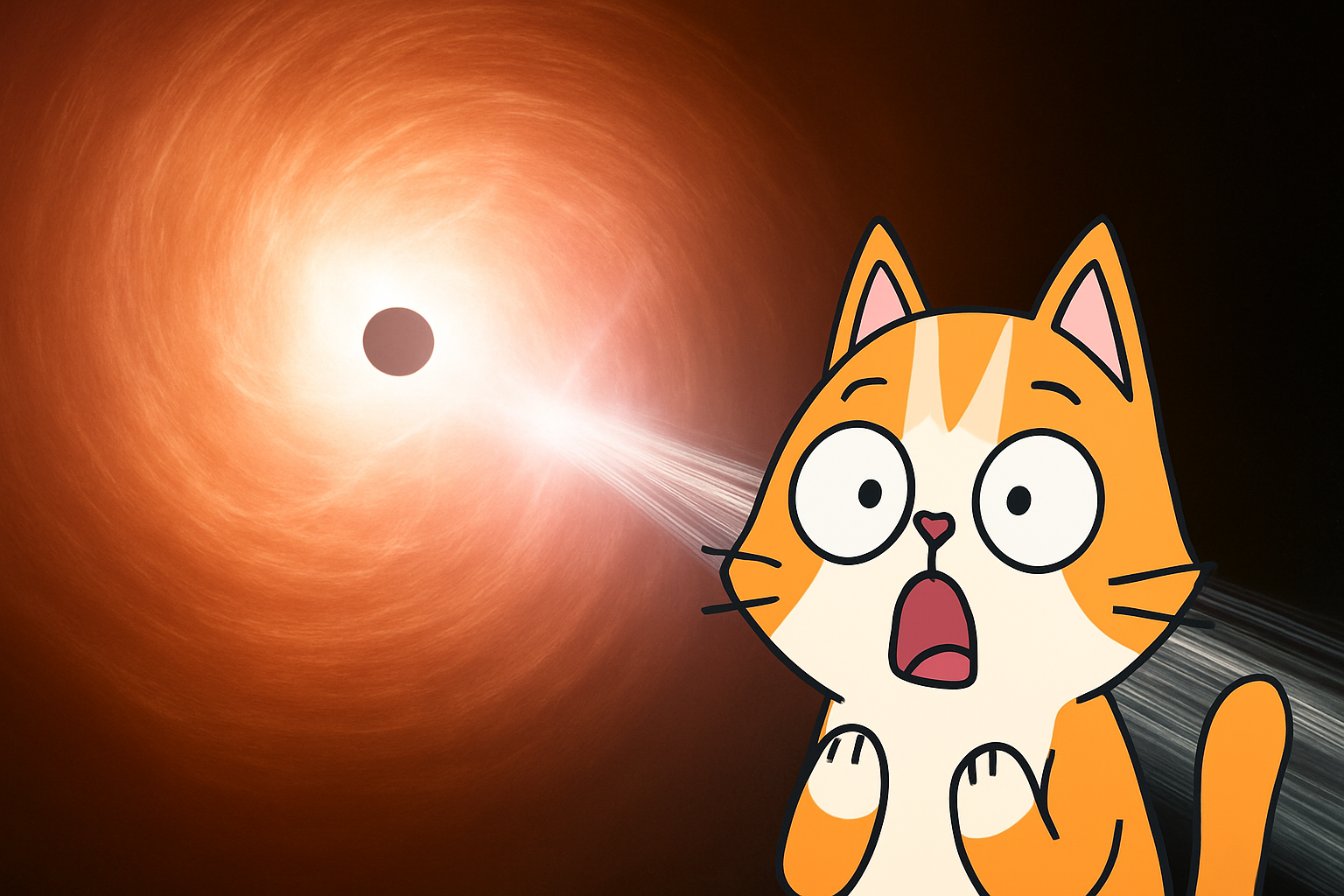
Monster Black Hole Defies Physics, Growing 2.4 Times Beyond Theoretical Limit
Astronomers have discovered a cosmic giant that's rewriting the rules of physics. A monster black hole in the early universe is devouring matter at more than twice the theoretical speed limit, deepening one of astrophysics' greatest mysteries.
Breaking the Universal Speed Limit
Using NASA's Chandra X-ray Observatory, scientists focused on an ancient black hole called RACS J0320-35, born just 920 million years after the Big Bang. Even in that early cosmic era, when the universe was only one-fifteenth its current age, this black hole had already swelled to roughly 1 billion times the mass of our sun.
The shocking discovery? This supermassive monster is growing at 2.4 times the Eddington limit—a theoretical ceiling that defines how fast black holes can grow based on the delicate balance between their outward radiation pressure and inward gravitational pull.
"It was a bit shocking to see this black hole growing by leaps and bounds," said lead researcher Luca Ighina from the Harvard and Smithsonian Center for Astrophysics.
A Perfect Laboratory for Understanding Growth
The researchers observed intense X-ray emissions blasting from the black hole at different wavelengths, combining this data with infrared and optical observations to calculate its mass and growth rate. Their analysis revealed the black hole consumes between 300 to 3,000 suns' worth of matter every year.
This makes RACS J0320-35 what scientists call a "super-Eddington" object—one that shouldn't be able to exist according to our current understanding of physics. How it manages to surpass this limit without becoming unstable remains a profound mystery.
Implications for Early Universe Models
Working backward from the black hole's current size and growth rate, researchers determined it could have started as a typical stellar-mass black hole formed from a collapsed star less than 100 times the mass of our sun. This finding suggests that rapidly growing black holes may be far more common in the ancient cosmos than previously thought.
The discovery joins other similar objects spotted by the James Webb Space Telescope, hinting that the early universe may have been populated by these physics-defying giants. These rapid feeders also appear more likely to emit enormous energy jets that pierce through space—exactly what RACS J0320-35 displays.
The Big Questions Remain
This remarkable black hole is helping scientists tackle one of astrophysics' most fundamental questions: How did the universe create its first generation of supermassive black holes, and how did they grow so massive so quickly?
"This remains one of the biggest questions in astrophysics and this one object is helping us chase down the answer," said study co-author Thomas Connor, also from Harvard and Smithsonian.
As astronomers continue studying RACS J0320-35 and similar objects, they're unlocking secrets about the universe's earliest epochs and challenging our understanding of cosmic evolution itself.
The research was published in The Astrophysical Journal Letters.